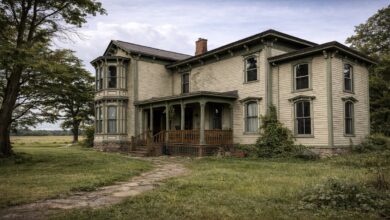
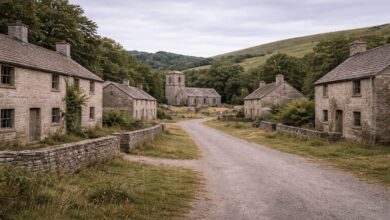
In the quiet village of Harrisville, surrounded by forested land and narrow roads, stands a modest 18th century farmhouse commonly referred to as the Harrisville House. Unlike grand castles or abandoned institutions, this structure is ordinary in scale and appearance. Its reputation, however, has grown far beyond its physical footprint. Over time, personal testimony, later retellings, and popular media transformed a private residence into a widely recognized symbol of unresolved experience.
The Harrisville House is frequently framed through dramatic language, yet its significance is better understood through restraint. It represents how domestic spaces accumulate meaning through family memory, interpretation, and repetition. The house itself does not provide answers. It provides continuity, a setting where experience and narrative became inseparable.
A house rooted in early settlement
The Harrisville House was constructed in the early 1700s during a period of rural expansion in New England. Farmhouses of this era were built for endurance rather than display. Thick timber frames, modest room divisions, and functional layouts defined their character.
The surrounding land supported agriculture and seasonal labor. Life here followed predictable rhythms shaped by weather, isolation, and self reliance. Houses were not only shelters but workspaces, often occupied by multiple generations. Similar human responses to silence and environment appear in the Winchester Mystery House.
This practical origin is essential. The house was never designed to impress or intimidate. It was designed to sustain daily life.
Domestic space and continuity
Over centuries, the house changed occupants but retained its basic structure. Additions were limited. Interiors reflected use rather than renovation. Such continuity allows layers of habitation to accumulate.
Domestic spaces differ from public ones in how memory attaches. Kitchens, bedrooms, and staircases absorb routine. Sounds, movements, and habits repeat.
When families live closely within the same structure for long periods, interpretation of space becomes personal rather than architectural.
Family experience and testimony
The Harrisville House entered broader awareness through accounts provided by a single family during the twentieth century. These accounts described a range of experiences interpreted as unusual or disturbing by those involved.
Importantly, these descriptions were framed as personal experience rather than objective record. They reflected how the occupants understood their environment at the time.
Family testimony carries emotional weight but is also shaped by stress, expectation, and circumstance.
The role of interpretation
Human perception does not operate in isolation. Once an experience is labeled as unusual, subsequent experiences are interpreted through that lens.
In domestic settings, ordinary phenomena such as temperature variation, sound transmission, or structural movement can take on meaning when framed narratively.
The Harrisville House illustrates how interpretation compounds over time, especially in environments already associated with age and isolation.
Architecture and sensory conditions
The house’s age contributes to sensory irregularities. Wooden structures expand and contract. Floors creak. Air moves through unseen gaps. Light shifts unevenly.
In rural environments, external sounds carry differently at night. Wildlife, wind, and distant activity can seem close.
These factors are not defects. They are characteristics of historic structures.
Media involvement and expansion
Decades after the original family accounts, the Harrisville House became linked to popular media. Dramatized retellings expanded awareness and fixed certain interpretations in public consciousness.
Media framing simplified complex personal experiences into recognizable narrative forms. Once circulated widely, these versions replaced nuance with familiarity.
The house became a reference point rather than a residence.
Separation between place and portrayal
As media attention grew, the physical house receded from public access. What most people know of Harrisville comes from secondary portrayal rather than direct encounter.
This separation allowed reputation to evolve independently of the structure itself. The house no longer needed to be visited to be discussed.
Narrative overtook material reality.
Psychological environment of isolation
Rural isolation plays a significant role in perception. Reduced external stimulus increases internal focus. Silence magnifies sound. Darkness limits visual reference.
In such settings, emotional responses intensify. Stress, fatigue, and uncertainty become more noticeable.
The Harrisville House existed within this psychological environment long before it gained a reputation.
Memory and reinforcement
Memory is not static. Recollection changes as stories are retold. Certain elements are emphasized. Others fade.
When accounts are repeated publicly, they stabilize around core images. These images then shape how the place is remembered.
The house becomes a container for memory rather than evidence.
Distinguishing history from narrative
Historically, the Harrisville House is a surviving example of early American rural architecture. Its construction, location, and function are well within regional norms.
Narrative overlays do not alter that history. They coexist with it.
Understanding the site requires separating architectural fact from interpretive story.
Ordinary structures and extraordinary meaning
One reason the Harrisville House resonates is precisely because it is ordinary. It resembles thousands of other farmhouses across New England.
This familiarity allows people to imagine themselves within it. Meaning becomes transferable.
Extraordinary claims attached to ordinary settings feel closer and more personal.
Cultural context of belief
Belief systems influence interpretation. In different eras, unexplained experiences have been attributed to religion, superstition, psychology, or environment.
The Harrisville House sits at the intersection of these frameworks. Its story reflects cultural attitudes as much as individual experience.
Understanding this context clarifies why interpretations differed across time.
Absence of physical transformation
Unlike abandoned or ruined sites, the Harrisville House was not destroyed or left to decay. It remained structurally intact.
This continuity allowed narrative to persist without interruption. The house did not become a ruin. It remained a home.
This distinction separates it from many places labeled haunted.
Why the reputation persists
The reputation persists because it is reinforced through repetition. Media, discussion, and reference continue long after direct experience ended.
The house functions symbolically. It represents unresolved interpretation rather than ongoing activity.
Persistence does not require evidence. It requires attention.
A private place in public memory
Despite its fame, the Harrisville House remains a private structure. It is not a museum or public site.
This privacy adds distance. Distance increases abstraction.
The house exists more clearly in imagination than in geography.
Between testimony and understanding
Testimony deserves respect, but it also requires context. Experiences are real to those who have them, regardless of explanation.
Understanding does not require dismissal. It requires careful framing.
The Harrisville House is best understood as a case of lived experience shaped by environment, expectation, and later narrative expansion.
A lesson in how places acquire meaning
The Harrisville House demonstrates how meaning attaches to domestic spaces. Ordinary structures can become extraordinary through interpretation.
Once a narrative takes hold, it reshapes memory, attention, and cultural reference.
The house did not change. Its story did.
Why Harrisville matters today
Harrisville matters because it shows how modern legends form. Not through ancient myth or dramatic ruin, but through family experience and media repetition.
It illustrates how private memory can become public symbol.
The lesson lies not in what occurred, but in how it was remembered.
A house defined by continuity
Ultimately, the Harrisville House remains what it always was: a rural farmhouse built for living. Its reputation reflects layers added long after construction.
The house stands as evidence that places do not need to be grand or abandoned to carry weight.
Meaning accumulates through attention.
In Harrisville, Rhode Island, a quiet structure became a lasting cultural reference. Not because of what can be proven, but because of how experience, interpretation, and repetition aligned. The house endures not as a mystery to solve, but as a case study in how stories attach themselves to place. Related reflections on memory and perception can also be found in Raynham Hall.
Horizon Report documents places shaped by memory, infrastructure, and human decisions. Our editorial approach focuses on what remains physically visible, how abandonment unfolds over time, and how interpretation is clearly separated from observable evidence.
For readers seeking deeper context, the following background articles explore how ghost towns emerge, why communities are left behind, and why preservation matters in understanding collective history.
- Abandonment And Ghost Towns
- What Is A Ghost Town
- Why Towns Are Abandoned
- Preserving Abandoned Places
Editorial transparency matters. Observations are grounded in site layout, materials, remaining structures, and documented timelines where available. Interpretive layers are presented as interpretation, not assertion.
Careful readers often notice details worth refining. Thoughtful feedback helps ensure accuracy, clarity, and long term editorial integrity.